Targeting-evidence map
Define intended cells or tissue, route, delivery mechanism and functional endpoint before selecting readouts.
Scientific advisory / tLNP / RNA
Connect RNA quality and formulation attributes to evidence for delivery and function in the intended target cells.
The analytical question
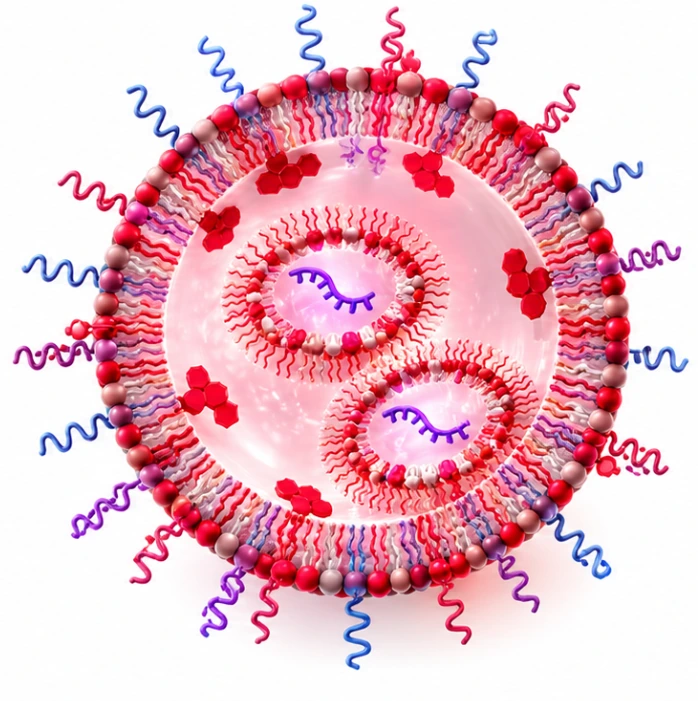
Targeted lipid nanoparticles (tLNPs) require a precise definition of targeting. Ligand-mediated recognition, composition-dependent tropism and a desired tissue distribution are different hypotheses. We help translate the intended payload, target cell and functional outcome into a coherent analytical study plan.
Potential workstreams
The final scope is agreed for the product, development stage and scientific decision.
Define intended cells or tissue, route, delivery mechanism and functional endpoint before selecting readouts.
Assess RT-qPCR or RT-dPCR alongside orthogonal approaches for payload integrity, identity and relevant RNA impurities.
Identify candidate physicochemical assays and dependencies between RNA recovery, particle disruption and analytical readout.
Where applicable, plan ligand identity, conjugation, accessible presentation and binding assessment without equating binding with intracellular function.
Define appropriate nontargeted or ligand controls, target-positive and target-negative comparisons, and specificity assessments.
Review provider-generated results across RNA, formulation and biological studies; document unresolved questions and follow-up priorities.
Consulting deliverables
Depending on the agreed engagement, outputs can include:
These are proposed advisory outputs, not claims of completed experiments or validated performance. Laboratory execution and provider responsibilities are scoped separately.
Fluorescence, tissue accumulation or ligand binding alone does not demonstrate productive delivery to the intended cells. Animal tropism does not establish human targeting. Delivery efficiency, tissue exclusivity and therapeutic efficacy require product-specific evidence.
No. Encapsulation, RNA integrity, intracellular release and biological activity are different attributes. A formulation can perform differently across these readouts.
No. The relevant attributes depend on the payload and intended use. For example, attributes associated with mRNA capping or poly(A) do not apply identically to every RNA modality.
These sources inform the scientific principles. They do not establish company credentials or endorse Genometrion.
Editorial review: 31 October 2026.
Start with the question
Define the scientific question behind your project. We can discuss the evidence, methods and practical next steps.
Scientific enquiries
A brief, nonconfidential outline is a useful starting point.
contact@genometrion.comEmail GenometrionOpens your email application. Contact details and enquiry guidance.